AI agents no longer just answer questions: they also simulate people. Stanford builds computational replicas of 1,052 real individuals that, 85% of the time, answer surveys the same way the original humans do. Google DeepMind maintains an open library for simulating entire societies. MIT recreates, agent by agent, the 8.4 million inhabitants of New York. And with some brands and institutions we are starting to rehearse launches, messages and pricing strategies with synthetic populations before spending a euro in the real world. If you work in marketing, product or strategy, this hits you squarely: your customers are already being simulated, and the next time someone sells you "synthetic consumers" you'll want to know what's behind it, what actually works and what's snake oil. The foundation of these simulations has a name, thirty years of science and founding papers you can read whenever you like: agent-based simulation models, known as ABMs.
In my own experience, this is a story of a few successes and many failures. In the early 1990s, in the Computer Architecture unit at the Universitat Autònoma de Barcelona, two researchers crossed paths who believed that simulating the world was not only possible: it was necessary. And we trusted it could be done individual by individual. Remo Suppi, far more senior than I was, joined a line of work that at the time looked like pure science fiction. In my own department, Antonio Espinosa was working on the automatic performance analysis of parallel programs, and enthusiasts of autonomous automata like Maite López-Sánchez and me were sketching cooperative-robot scenarios; she, in particular, was investigating how robots (agents) could collaborate to build maps of an unknown environment: autonomous navigation and cooperative map building by mobile robots. In 1994 these topics were theory, but we saw them as fully feasible.
I came from working on PROMETHEUS (Programme for a European Traffic of Highest Efficiency and Unprecedented Safety), a project funded by the European Community until 1995, to guide an autonomous vehicle on networks of transputers, the British INMOS microprocessors of massive parallelism (SUPERNODE was built with them) in which each chip was an autonomous unit with its own memory and its own message channels. We had actually stumbled onto a double metaphor without knowing it: the car was an agent perceiving and deciding in its environment, and it was driven from the inside by a swarm of processor-agents passing messages. Out of that came my 1993 postgraduate research on predicting the performance of parallel systems through simulation.
The idea we defended had no name. Ecologists called it "individual-based models", social scientists said "microsimulation", and in artificial intelligence it was often mistaken for plain distributed systems. The typical comment from my colleagues was: "those are just programs with objects, that doesn't scale, that can't be validated, that isn't serious science". Serious science meant differential equations, aggregate models, the representative agent. We believed in something else: in populations of agents with simple rules, interacting, out of which emerged behavior nobody had programmed.
Thirty-three years later, that crazy corridor idea is the frontier of AI: even central banks calibrate agent models for financial stress. And at 498A, our R&D lab, we've turned the first stretch of that conviction into a product already used by internationally renowned brands.
This article is a simple, well-informed explanation of what an agent-based model is and of the progress of the 1993-96 period in which the foundations, the manifesto and the original toolkit of this discipline were built. And the map of how that tradition flows, thirty years later, into what we're building with GEORadar as its first component: simulating the decision-making of synthetic people. I'll also tell you about several things we still don't know how to do, because in this field there's a lot of fear that, if we talk about the limits and the walls we crash into every day, the spell will break and everyone will realize that AI wasn't built in one summer, and that there's still a long, long way to go.
Two ways to explain a system
When you want to understand a system made of many parts, say a market, a city, an epidemic or the perception of a brand, there are two roads.
The classical road goes top-down. You write equations for the aggregates: total demand, average speed and infection rate. It works wonderfully when the parts are identical and interchangeable, like the molecules of a gas. And it doesn't work when the parts are heterogeneous, when they learn, imitate each other and react to one another. Whatever you couldn't capture in the equation stops existing: a bubble, a phantom traffic jam, a rumor that goes viral and nobody knows why.
The opposite road goes bottom-up. You define a population of autonomous agents, each with simple local rules: it perceives its environment, decides, acts, interacts. You run the simulation thousands of times and watch which macroscopic pattern emerges without anyone having explicitly programmed it. That's an agent-based model, an ABM. It isn't a point-prediction technique; it's another epistemology. You don't ask "what number will come out?", you ask "what futures can arise from these rules?".
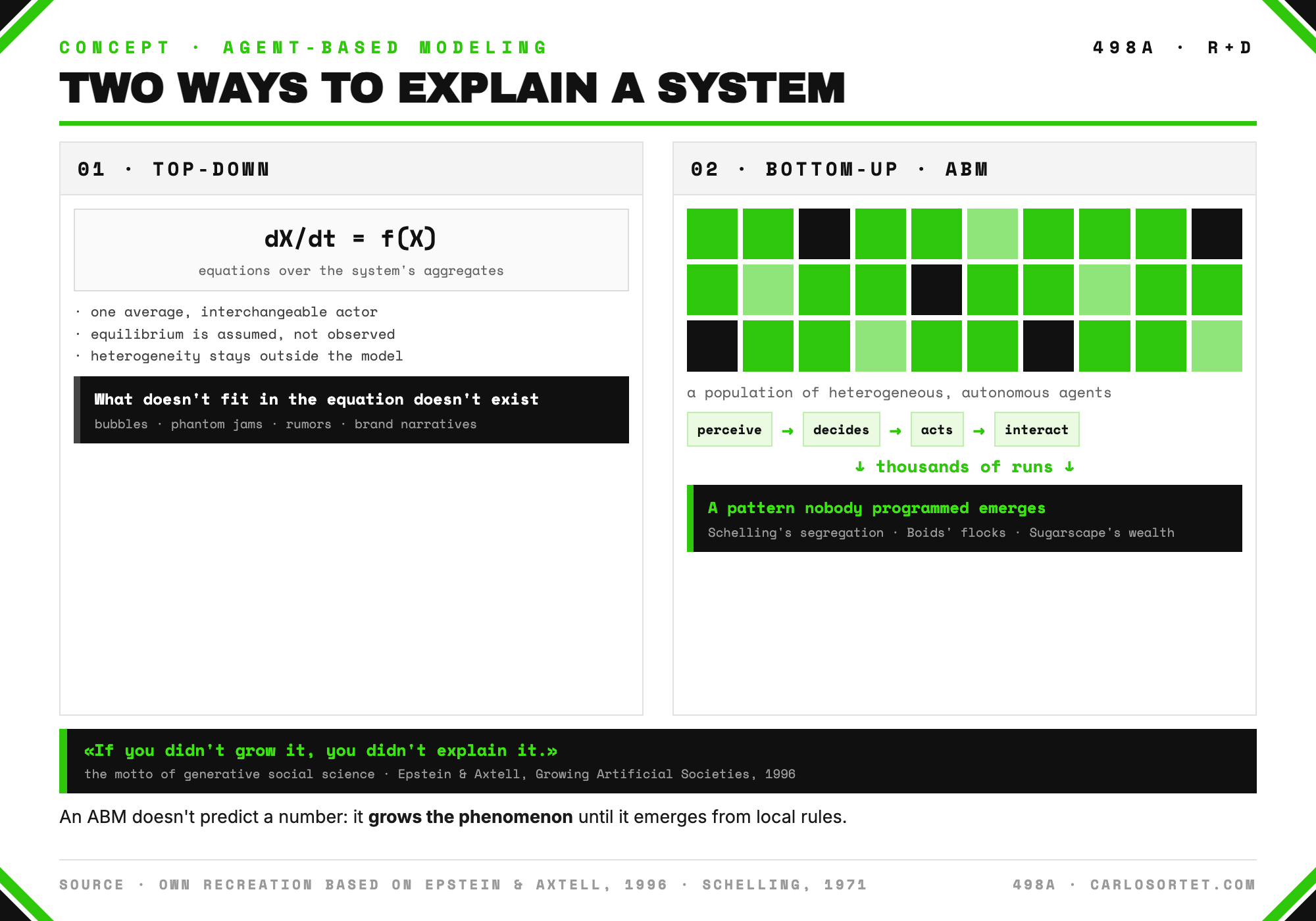
Two philosophies: describe the whole or grow the phenomenon. Source: own recreation based on Epstein & Axtell, 1996, and Schelling, 1971.
The founding case didn't even need a computer. In 1971, Thomas Schelling studied urban segregation using coins on a board. Each coin followed a single rule: if fewer than a third of my neighbors are like me, I move. A very simple and subtle individual preference. The result, after a few rounds: the board ended up completely segregated. Nobody decisively wanted segregation, yet segregation arose all the same. This is the intellectual revelation of ABM: the macro is not the sum of the micro, it's its consequence. Then came other equally fascinating experiments: Conway's Game of Life (1970) and Craig Reynolds' Boids (1987), a simulation of perfect bird flocks generated by three local rules, with no leader and no choreographer. What's fascinating about these theories is realizing that no orchestrator is needed. Some even carried these findings over to political and social systems: maybe you don't need a leader or a control system; maybe, if we all respected a few very simple rules, harmonious behavior would emerge and progress from freedom would be possible. These systems are explained beautifully in Steven Johnson's book Emergence: The Connected Lives of Ants, Brains, Cities, and Software (2001). Highly recommended.
By the time I arrived at UAB, none of this had yet been defined as a field of work. My enthusiasm for these simulations was something endearing, like the doctor who loves cats: almost a distraction from real science.
1993-1996: the moment when it all took shape, we gave it a name, a manifesto was published and the first systems were built
Almost all of it came out of the Santa Fe Institute as working papers that are still available online today. I've retrieved them all, and rereading them is an exercise in humility: almost everything that looks new today was already there, waiting for computing power and a decent artificial mind.
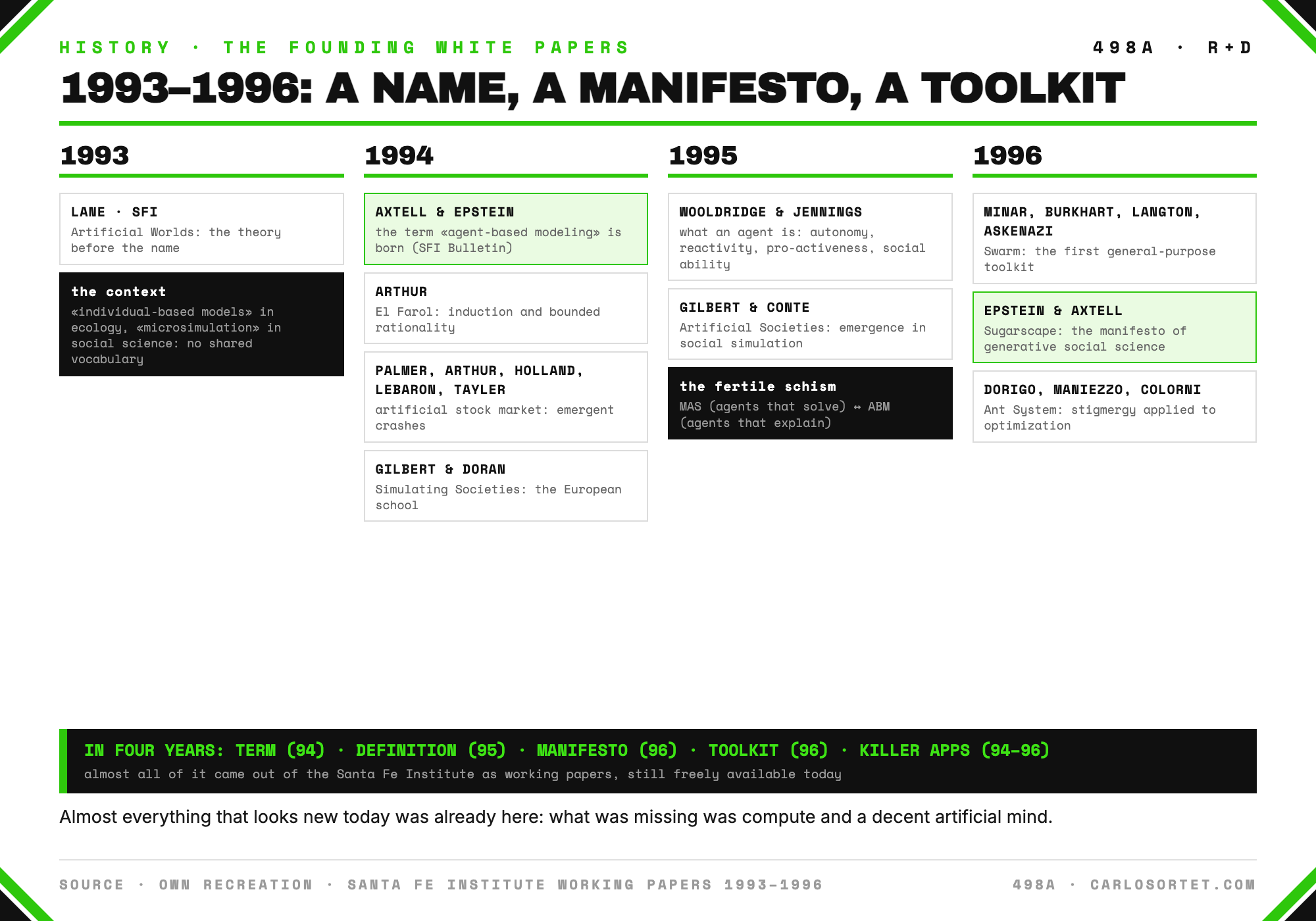
Four years to found the discipline and build the first killer apps. Source: own recreation.
1993. The theory. David Lane publishes Artificial Worlds and Economics as an SFI working paper: the first serious conceptual frame for "artificial worlds", bottom-up simulations to study how hierarchical organization emerges in an economy. The full text stands today as a visionary manifesto.
1994. The baptism. Robert Axtell and Joshua Epstein publish in the SFI Bulletin a short piece titled Agent-Based Modeling: Understanding Our Creations. It's the starting point, the birth of the term ABM. That same year, Brian Arthur presents the thought experiment that would become the "hello world" of complexity economics: the El Farol problem, an SFI working paper that the American Economic Review published as Inductive Reasoning and Bounded Rationality.
El Farol deserves two paragraphs, because it's the direct seed of what we do today and strikes me as a super-intuitive case that illustrates the concept perfectly. It's a bar in Santa Fe with Irish music on Thursdays. A hundred people want to go, but it's only enjoyable if fewer than sixty show up. No communication or coordination is possible: everyone decides at home, with their own theories about how many people will go. If everyone reasoned the same way, deductively, the system would go to an extreme and stop working: everyone would go or no one would. Arthur equipped his hundred agents with inductive reasoning: each one keeps a small repertoire of predictive models, uses the one that works best and discards it when it fails. We're talking about an experiment from 1994! There were no LLMs to give those agents advanced cognitive abilities, but, at the architecture level, it's exactly what we'd build today.
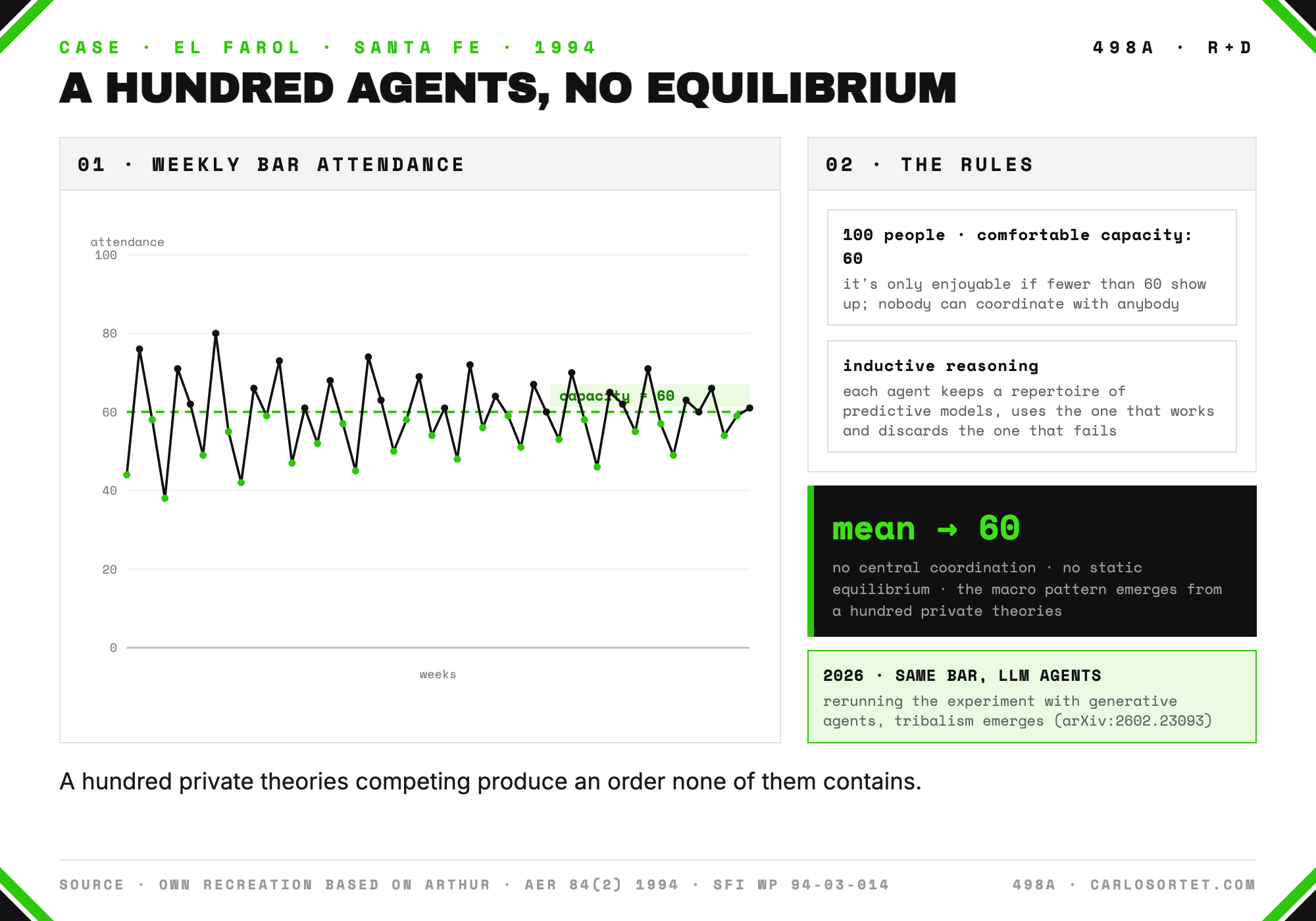
A hundred private theories competing produce an order that was established in none of them: mean attendance fits the capacity perfectly. Source: own recreation based on Arthur, AER 84(2), 1994.
The result is hypnotic: mean attendance self-organizes around sixty, exactly the capacity, without ever converging to a preestablished static equilibrium and without any agent knowing the full system. A market in miniature, with genuine bounded rationality. In February 2026, a team put agents back into Arthur's bar, this time with LLMs inside, and out of the conversations emerged tribalism worthy of Lord of the Flies: the agents organized into groups that coordinated their attendance or decided not to show up at the bar. Thirty-two years later, the same experiment keeps producing surprises. To me, that means it really is a good model.
That same year, Palmer, Arthur, John Holland, Blake LeBaron and Paul Tayler published in Physica D the Santa Fe artificial stock market: adaptive agents buying and selling securities, with bubbles, crashes and persistent volume as emergent properties, with no prior assumptions or behaviors (open access text; the mature version, Asset Pricing Under Endogenous Expectations, arrived in 96). If I had to point at GEORadar's direct ancestor today, it would be this paper: replace "asset price" with "brand narrative" and "agents' expectations" with "the AI engines' perception" and the conceptual skeleton is the same. In parallel, in Europe, Nigel Gilbert and Jim Doran were founding the social school with Simulating Societies, and Kathleen Carley and Michael Prietula opened the organizational branch with Computational Organization Theory: organizations as collections of task-oriented adaptive agents.
1995. The definition. Michael Wooldridge and Nick Jennings publish the most cited survey of the era, Intelligent Agents: Theory and Practice, and fix the canonical definition of an agent: autonomy, reactivity, pro-activeness, social ability. There the field forks into two branches that are worth not confusing, because there's still confusion today. Multi-agent systems (MAS) are an engineering solution: agents that solve problems, negotiate, orchestrate. ABM is science: agents that explain phenomena through emergence. One builds systems; the other builds understanding. That same year, Gilbert and Rosaria Conte publish Artificial Societies, now open access, with Gilbert's chapter on emergence in social simulation, still the best conceptual introduction I know. One more note: the MAS branch scored a milestone very early on our own campus, because between 1996 and 1998, at the IIIA-CSIC in Bellaterra, a team with Juan Antonio Rodríguez-Aguilar (JAR) among its authors turned the descending-price auction of the fish market into FishMarket, an agent-mediated electronic auction house: software agents buying and selling fish inside an electronic institution. To this day, what JAR did back then strikes me as mind-blowing.
1996. The tools. Nelson Minar, Roger Burkhart, Chris Langton and Manor Askenazi publish the white paper for Swarm, the first general-purpose toolkit for building multi-agent simulations. Among the authors are the father of artificial life (Langton, SFI) and an engineer from John Deere (Burkhart); it was already sensed that all of this would be good for something. Until Swarm, every ABM was written from scratch, in C or Lisp, bare-handed. That's how we all worked, scratching at the keyboard and trying to keep the implementation from getting so complicated it killed the experiment.
Joshua Epstein and Robert Axtell publish Growing Artificial Societies (Brookings/MIT Press), the reference manifesto for the future. Their model, Sugarscape, is brutally elegant: a landscape of sugar, agents with vision and metabolism, rules for moving, eating, trading, reproducing. From those rules emerge migrations, wealth distributions skewed like the real ones, trade, war, cultural transmission, epidemics. The book's thesis is expressed in a single sentence that became the motto of all "generative social science": if you didn't grow it, you didn't explain it. There's even a modern formal specification for anyone who wants to reimplement it, which is the best ABM learning exercise there is.
And Marco Dorigo, Vittorio Maniezzo and Alberto Colorni publish Ant System in IEEE Transactions: artificial ant colonies solving combinatorial optimization problems through the deposition of digital pheromone. Pure stigmergy, applied ABM founding the entire field of colony optimization. And a lesson in sociology and politics thrown in for free!
Why nobody believed we'd reach port: the three walls
If the 93-96 window was so fertile, why did ABM spend the next twenty-five years reviled by science? Because it crashed into three walls that took us decades to tear down.
The cognition wall. The agents of the 90s were toys. Four if-then rules, a state table, and a genetic algorithm if you were feeling fancy. Every critique was fair: "your fake humans don't think like humans". The modeler had to write the rules of a mind, and minds don't fit in hand-written rules.
The scale wall. Simulating a few agents was trivial, and simulating many, impossible. The compute power of the 90s allowed hundreds, maybe thousands, of simple agents. Any interesting phenomenon, a city, a real market, a pandemic, needs millions. And parallelizing a simulation where everyone interacts with everyone isn't distributing work, it's distributing conversations: the hardest synchronization problem in distributed computing.
The calibration wall. An ABM has dozens of parameters and no derivative. Fitting it to real data meant artisanal trial and error, expensive and barely reproducible. The econometricians, with their estimable models, were right not to take all this too seriously.
That invisible thread that binds us and drives us forward.
Faced with these barriers, I chose to hibernate the question and go into industry. Remo Suppi and the others stayed on; Remo defended his thesis at UAB in 1996, the same year as Swarm and Sugarscape, and spent the next three decades fighting to demolish one of the three walls: scale. His question: "what if agents could be millions?".
In 2002, with Pere Munt and Emilio Luque, he publishes Using PDES to Simulate Individual-Oriented Models in Ecology: fish schools, the individual-oriented model, on parallel discrete event simulation. In 2003 they add real-time 3D animation; later fuzzy logic inside each fish's head and increasingly refined cluster-distributed versions. Fish schools are pure emergence, leaderless self-organization, the Boids problem elevated to serious science.
Then the agents became people. His group, HPC4EAS, applied all of it to emergency evacuations: panicking crowds simulated agent by agent, first as a cloud service (Crowd Evacuations SaaS, ICCS 2015) — where I reconnected with the discipline, because there were clearly solutions with real-life impact — then with crowd turbulence on GPUs (ICCS 2016), and finally distilled into Care HPS, his high-performance agent simulation framework (Future Generation Computer Systems, 2017), applied among others to the evacuation of the Fira de Barcelona. The same conceptual engine ended up simulating tumor growth and urban mobility with real data and GIS maps.
All this progress fills me with pride and total respect for my department colleagues, and it also unsettles me: the problem of how many agents fit in the hardware is literally the general AI headline of 2026. How could that circle have closed so cleanly?
2023: the cognition wall falls
The unlock came thanks to language models.
In April 2023, Joon Sung Park and colleagues from Stanford and Google publish Generative Agents: Interactive Simulacra of Human Behavior, the "Smallville" paper: twenty-five agents living in a little Sims-style town, each with an LLM as a brain and an architecture of memory, reflection and planning around it. The agents have breakfast, go to work, meet, even gossip. Suddenly, one agent decides to throw a Valentine's Day party and, without anyone programming it, the invitations propagate, coordination emerges among simulated individuals, one invites their crush. Social behavior, emerging.
The reading of Smallville is that the cognition wall, the founding objection against ABM, falls. You no longer need to hand-write the rules of the agent's mind: they are obtained from a model trained on the knowledge of almost the entire web. A synthetic persona is no longer four if-thens; it's a full profile conditioning the responses of a statistical mind (LLM).
Validation arrived in November 2024: Park's team interviewed for two hours 1,052 real people, a representative sample of the US, and built one generative agent per person, fed with the interview transcript. Then they gave the agents the General Social Survey, personality tests and economic games. The result: the agents replicate their humans' answers with a normalized accuracy of 85%. The percentage is very important because it is the threshold of agreement of the people with themselves when retaking the questionnaire two weeks later. And with less bias across racial and ideological groups than agents described only with demographics.
Around that result an entire ecosystem has rapidly crystallized:
- Concordia, from Google DeepMind, is an open library for generative ABM with a tabletop-RPG "Game Master" pattern: the game master simulates the environment, the agents play (paper, experiment design guide). It's on version 2.0 and is used from social science to service evaluation.
- Project Sid, from Altera, dropped more than a thousand autonomous agents into Minecraft with their PIANO architecture: a merchant hub emerged, economic roles, a religion that spread, and a constitution the agents voted on and amended. Civilization in miniature as a tech demo.
- AgentSociety (2025) simulates more than ten thousand agents with minds equipped with emotions, needs and motivations, and logs five million interactions to study social dynamics: polarization, misinformation spread, public policy.
- GATSim brings generative agents to urban mobility, and EconSimulacra (June 2026) builds digital twins of full socio-economic systems with LLM agents.
This movement is already called GABM, generative agent-based modeling, and it's the fusion of the two 1995 traditions we've discussed: the mind comes from the MAS-LLM branch, the method comes from the ABM branch. The two branches of Wooldridge and Epstein, finally reunified. Whenever I think about it, I go back to the UAB corridor where we defended both without knowing it.
The other revolution: the scale and calibration walls fall
While the media spotlight went to the agents that talk, the other half of the problem, Remo's half, was being solved with the same force.
Ayush Chopra's group at the MIT Media Lab built AgentTorch, the framework for Large Population Models: agent simulations written as differentiable tensors, running on GPU. Their flagship result answers exactly the corridor question: they simulated the 8.4 million inhabitants of New York during the pandemic, agent by agent (AAMAS 2025). The trick for giving agents an LLM head without going bankrupt on API calls is elegant: archetypes. You don't call an LLM per agent; you prompt a set of archetypes, synthetic personas capturing behavioral segments, and their decisions govern the populations they represent (accessible explainer, Large Population Models). That is exactly how a persona works in GEORadar.
And the calibration wall fell with differentiable ABM. If you rewrite the simulation so it admits derivatives, calibrating it against real data stops being craftsmanship and becomes gradient descent, like training a network. GradABM simulates populations of millions in seconds on commodity hardware and calibrates with neural networks; there's Bayesian calibration of differentiable ABMs, variational inference with Gaussian-process surrogates and a recent treatise on automatic differentiation of ABMs (September 2025). This is no longer speculative academia: central banks review in 2025 their production ABMs for systemic risk, and regional vaccination policy is calibrated with neural-network-accelerated ABMs.
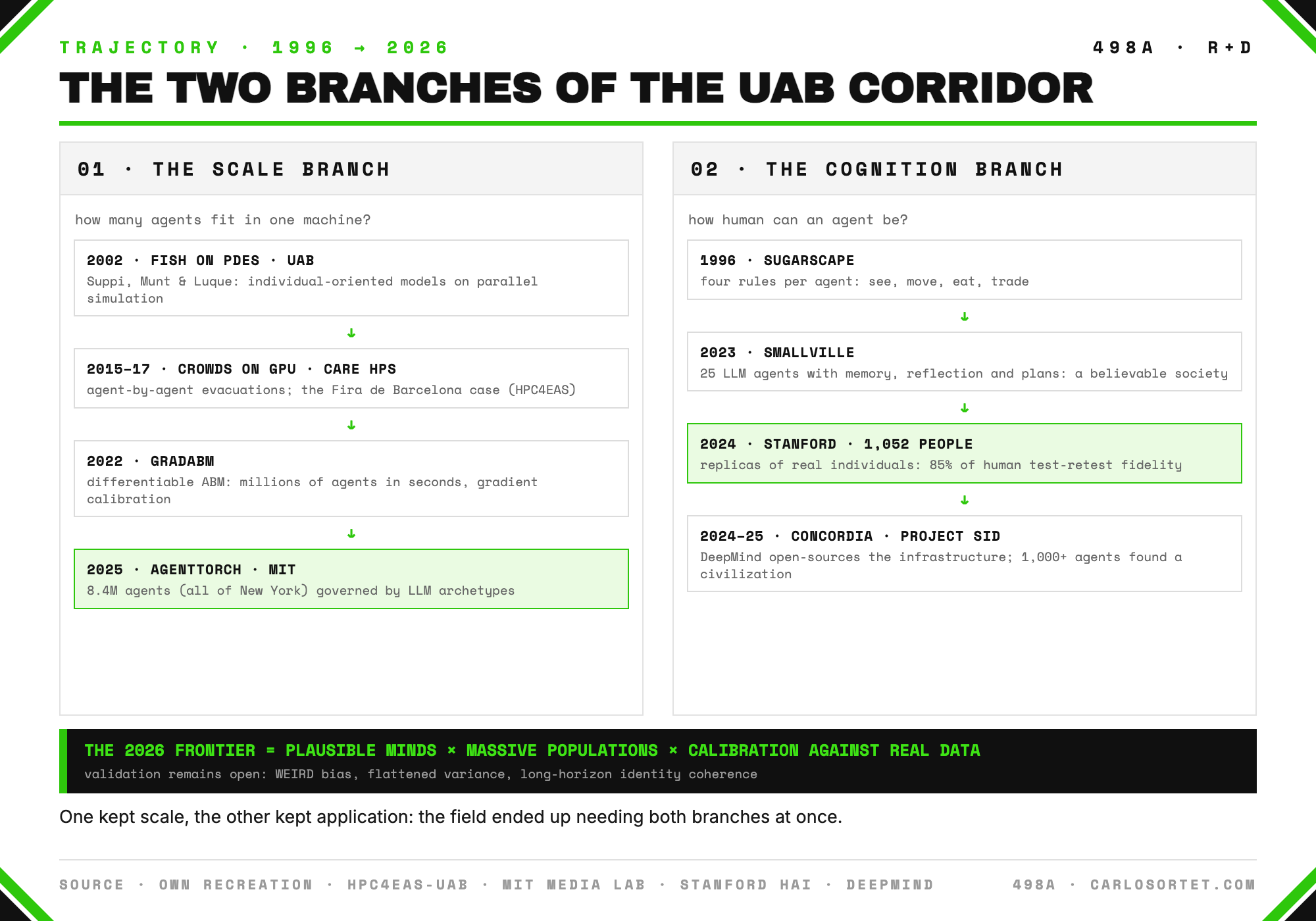
The branch focused on solving the scale challenge and the branch centered on cognition converge thirty years later. Source: own recreation.
In 2026 the cognition branch has achieved plausible agents and the scale branch has achieved calibratable massive populations, and the frontier is marrying them. Rich minds × millions of agents × calibration against real data. If we manage to join the three, we will build that society simulator that in 93 was a fantasy.
It's important to make clear that validation remains open. There's critical literature showing that LLM-based human simulations are not yet reliable for many uses: bias toward WEIRD populations, variance flattening (agents are more homogeneous than the humans they imitate), sycophancy, identity drift over long horizons. It's being attacked from several flanks, from identity coherence with retrieval to automated causal discovery of why what emerges emerges (April 2026). It's exactly the validation problem the econometricians threw at us in the 90s. Everything changes, everything stays the same. The difference is that now the field has tools, money, and Stanford, DeepMind and MIT working on it. Back then we were two cats in a lab that, literally, still had oscilloscopes sitting on the tables.
From measuring perception to simulating decision: the GEORadar milestone
Our underlying goal at 498A is the agentic simulation of human decision-making: being able to run a synthetic population against a scenario, a brand, a message, a possible future, and observe what perception forms and what decisions emerge, a system for exploring possible futures, for preparing for the worst and helping the best happen, a system that can measure how much a certain information diet can manipulate decisions, a system that avoids learning through the suffering of a collective, that allows learning without spending the budget in the real world. What we've always had in mind: simulating futures. A chess game played millions of times, where the pieces make their own decisions and we can assess whether winning the game justifies the pain and the cost in pieces to reach that victory.
GEORadar is the first milestone of that goal turned into a product, and understanding it as applied ABM explains better than anything why it works. When we audit how generative AI surfaces see a brand, we don't throw four generic questions at a chatbot. We build a synthetic demand population: personas by segment, with classified intents (informational, transactional, skeptical, comparative), traversing the funnel stages; we evaluate the intent of each prompt and simulate conversations through an autonomous agent with a specific profile for a specific market. That population generates between 6,000 and 30,000 custom prompts per study, which we run against different models: ChatGPT, Gemini, Claude… A semantic completeness algorithm detects the saturation point, the moment when asking more no longer discovers anything new, which is the GEO version of any serious simulation's convergence criterion. The same kind of system that determines when a simulated conversation in GEORadar should end. And what we measure at the end is exactly an emergent property: the aggregate perception, share of voice, sentiment, attributes, narrative, that no individual prompt contains but the ensemble reveals. We've run more than a million simulated prompts and analyzed over 12 million brand mentions with this method.
The intellectual genealogy is operational. The concept-by-concept mapping:
| ABM concept, 1993-96 | In GEORadar, 2026 |
|---|---|
| Population of heterogeneous agents | Synthetic personas × intents × funnel stages |
| Bounded rationality and induction (El Farol) | Intent buckets: informational, transactional, skeptical, comparative |
| Environment the agent interacts with | The generative AI engines (5 LLMs + Google AI Overviews and AI Mode) |
| Ensembles and parameter sweeps | 6,000-30,000 prompts with a semantic saturation algorithm |
| Running the model on several "worlds" | Multi-engine as a narrative robustness test |
| AgentTorch's archetypes | Personas representing entire demand segments |
| Measured emergent property | Brand perception: SOV, sentiment, attributes, narrative |
What we do today is, really, microsimulation at scale: massive independent samples. It's a harnessed lab, not full ABM. What defined a 96-vintage ABM was interaction with feedback: agents affecting each other and the environment, and from there emergence arose. That's exactly the next stretch of the roadmap, and every piece is a feature with a name: multi-step journeys with memory, the agent reads the engine's answer, updates its consideration set and asks again, from skepticism to comparison, like a real person; population feedback, what happens to aggregate perception when 20% of agents discard the brand at the second interaction; social dynamics, synthetic word of mouth, the between-agent influence Axelrod modeled for culture; and counterfactuals, the same population running against two different brand narratives, two measurable futures before choosing one.
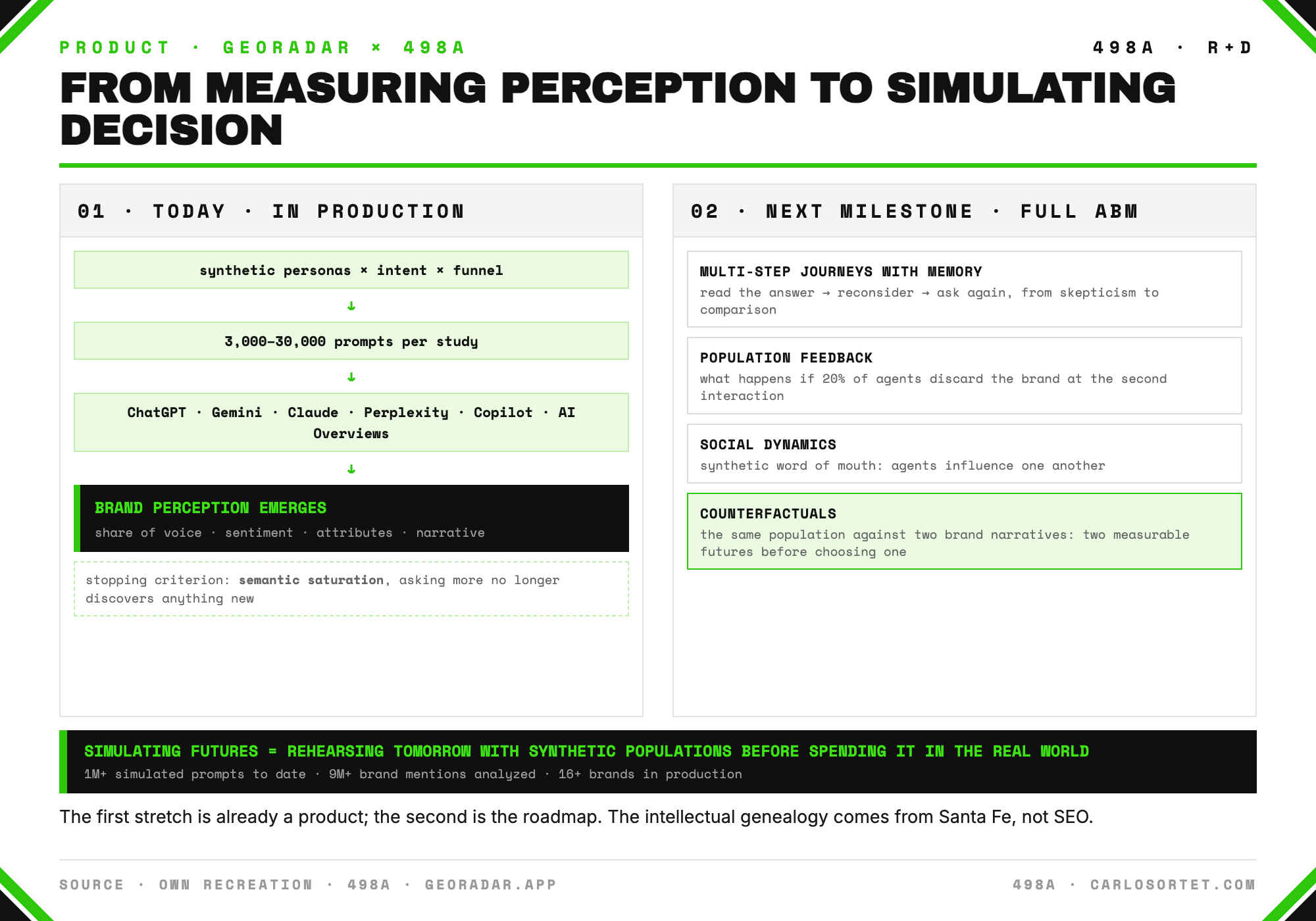
The first stretch is a product; the second is a plan toward simulation. Source: own recreation, 498A.
One of the goals of this text is to provide the frame that makes it evident that GEORadar doesn't descend from SEO; it descends from Santa Fe, from collaborative autonomous automata, from parallelism simulators. The practical difference between a GEO SaaS firing forty generic prompts and a study with a designed synthetic population isn't volume, it's epistemology: one runs surveys on an oracle, the other grows a phenomenon until it emerges and saturates. We aim for the same standards serious ABM developed over thirty years, convergence criteria, calibration against real data, sensitivity analysis: those are the metrics we demand of any synthetic-people simulation, ours included. The day someone sells you "synthetic consumers" without talking about validation, well, you know...
Coda: it has taken thirty years to be timely
In 93 they told us that wasn't serious science. The answer took thirty-three years and we didn't give it: it came from Stanford, DeepMind, MIT, the central banks and professors at UAB, IIIA, UPC and so many other centers where people as capable as Toni, Remo, Daniel, Tomás, Maite or JAR never stopped publishing. Arriving thirty years early is a drag, but in innovation it's the only way to arrive on time. The good heresies, the great ideas that will transform the future, always come disguised as nonsense.
Remo kept fighting to answer the question of how many agents fit in a machine, and his answer is today the branch MIT has taken to 8.4 million synthetic New Yorkers. I took the question outside the University, into the real world where people desperately try to manipulate real persons without caring much about the consequences. It's time we used all these advances to become wiser, more considerate and more prudent. There are issues to resolve that are not trivial. Knowing what an agent that resembles a person decides, and what that is for, is no longer a challenge for science alone: the answer lives at a crossroads. Realizing it took me many years, an entire career in brands and creating 498 Advance, an R&D lab.
They say that 'fools decide while the wise deliberate'; we hope our future simulation machine becomes a great aid for deliberating, for measuring consequences, for not forgetting collateral damage, and so that nobody has an excuse to act without weighing different scenarios. From 498 Advance's point of view, the simulation of groups, crowds and societies is inevitable, but it must not be monopolized by anyone, it must be designed for the good of all, and it must be grounded in all the efforts I've collected in this text. Without rigor, without validation and without quality data, simulation is a pastime.
What fascinates me most about the arc is that the idea hasn't changed. Schelling with his coins in 1971, Arthur with his bar in 1994, Epstein with his sugar in 1996, Stanford with its 1,052 interviews in 2024 and us with our demand populations in 2026 are doing exactly the same thing: giving up the search for the universal equation of the all-seeing god, the one scientists dreamed of for years. Instead, with humility, we switch a system 'on' and wait for the solution to emerge from the anthill. The great change has been going from the four rules we fed in back then to using a statistical mind trained on all of human culture. It hasn't been cheap, it hasn't been fast, but the future is very promising and we have it, almost, within reach.
Technical sources to learn more
The founding canon, 1993-1996
- Lane: Artificial Worlds and Economics, SFI Working Paper, 1993 (full text). The theory before the name.
- Axtell, Epstein: Agent-Based Modeling: Understanding Our Creations, Bulletin of the Santa Fe Institute, 1994. The birth certificate of the term.
- Arthur: Inductive Reasoning and Bounded Rationality (El Farol), American Economic Review 84(2), 1994 (original SFI working paper).
- Palmer, Arthur, Holland, LeBaron, Tayler: Artificial Economic Life: A Simple Model of a Stockmarket, Physica D 75, 1994 (open access); Asset Pricing Under Endogenous Expectations, SFI, 1996.
- Gilbert, Doran (eds.): Simulating Societies, UCL Press, 1994.
- Carley, Prietula (eds.): Computational Organization Theory, Erlbaum, 1994.
- Wooldridge, Jennings: Intelligent Agents: Theory and Practice, Knowledge Engineering Review 10(2), 1995 (Cambridge).
- Gilbert, Conte (eds.): Artificial Societies, UCL Press, 1995, open access; Gilbert: Emergence in Social Simulation.
- Rodríguez-Aguilar, Martín, Noriega, García, Sierra: Towards a Test-bed for Trading Agents in Electronic Auction Markets, AI Communications, 1998. FishMarket, IIIA-CSIC's electronic auction house.
- Minar, Burkhart, Langton, Askenazi: The Swarm Simulation System, SFI Working Paper, 1996.
- Epstein, Axtell: Growing Artificial Societies, Brookings/MIT Press, 1996 (MIT Press; formal Sugarscape specification).
- Dorigo, Maniezzo, Colorni: Ant System: Optimization by a Colony of Cooperating Agents, IEEE Transactions on SMC-B 26(1), 1996.
The scale branch: Remo Suppi and UAB's HPC4EAS
- Suppi, Munt, Luque: Using PDES to Simulate Individual-Oriented Models in Ecology, ICCS 2002.
- Suppi, Luque: Fish Schools: PDES Simulation and Real Time 3D Animation, PPAM 2003; A Fuzzy Logic Fish School Model, ICCS 2009; High Performance Individual-Oriented Simulation.
- Crowd Evacuations SaaS (ICCS 2015), Crowd Turbulence on GPU (ICCS 2016), Care HPS (Future Generation Computer Systems, 2017): see his DBLP page and the HPC4EAS evacuations page, with the Fira de Barcelona case.
- Tashakor, Suppi: Agent-based model for tumour analysis using Python+Mesa, 2019.
- González Cuevas, Suppi: ABM simulation focused on urban mobility.
- Institutional profile: UAB Research Portal and group publications.
The generative turn, 2023-2026
- Park, O'Brien, Cai, Morris, Liang, Bernstein: Generative Agents: Interactive Simulacra of Human Behavior, 2023. Smallville.
- Park et al.: Generative Agent Simulations of 1,000 People, 2024 (Stanford HAI summary). The 85% fidelity.
- Google DeepMind: Concordia, generative social simulation library (paper; reliable experiments guide).
- Altera: Project Sid: Many-agent simulations toward AI civilization, 2024 (code).
- Piao et al.: AgentSociety: Large-Scale Simulation of LLM-Driven Generative Agents, 2025.
- GATSim: Urban Mobility Simulation with Generative Agents, 2025; EconSimulacra: A Digital Twin Platform of Socio-Economic Systems, 2026. (Recent preprints.)
- Three AI-agents walk into a bar..., 2026. El Farol revisited with LLM agents. (Recent preprint.)
Industrial scale, differentiability and calibration
- Chopra et al.: On the Limits of Agency in Agent-Based Models, AAMAS 2025 (MIT Media Lab; AgentTorch); Large Population Models, 2025.
- Chopra et al.: Differentiable Agent-based Epidemiology (GradABM), 2022.
- Quera-Bofarull et al.: Bayesian Calibration of Differentiable Agent-Based Models, 2023; Automatic Differentiation of Agent-Based Models, 2025; calibration with Stein variational inference and Gaussian-process surrogates, 2025.
- Anirudh et al.: Accurate Calibration of Agent-based Epidemiological Models with Neural Network Surrogates, PMLR.
- Agent-Based Modelling at Central Banks: Recent Developments and New Challenges, 2025; neural-network calibration of ABMs for vaccine policy, Vaccine, 2023.
Validation and critique
- LLM-based Human Simulations Have Not Yet Been Reliable, 2025. The mandatory read before believing anything.
- ID-RAG: Identity Retrieval-Augmented Generation for Long-Horizon Persona Coherence, 2025. (Recent preprint.)
- CAMO: Automated Causal Discovery from Micro Behaviors to Macro Emergence in LLM Agent Simulations, 2026. (Recent preprint.)
Extended version, with the 498 Advance working method: Synthetic consumers: what to demand before buying them.